Bottom line: Stackby is a spreadsheet-style database tool, an alternative to Airtable, with dashboards, forms, document designs and a conversational AI builder. On AppSumo you buy it in codes, from 1 code at $109 up to 10 codes at $1,090, and the tier you get depends on how many you stack. That matters, because the listing’s headline promises “AI powered business apps,” yet the plan cards show zero apps until you reach 6 codes, and zero internal automations until 7. If you want a database your team can share, a low tier is fine. If you want apps and automations, budget for $654 or more, or look at a subscription.
Best for: small teams moving out of tangled spreadsheets who want views, forms and dashboards on shared data.
Think twice if: you’re buying for the apps or the automations, or you need more than 30 days to decide.
We have no affiliate deal with Stackby or AppSumo; links go to the official pages. How we review.
Updated 29 October 2026. This Stackby review rests on two pages we read that day: the Stackby listing on AppSumo, including every plan card and its ticks and crosses, and Stackby’s own pricing page. We haven’t run a team’s operations on it, so we report what each tier includes and what the terms say, not how it performs at 20,000 rows.
Stackby review at a glance
| What we checked | What the pages say |
|---|---|
| Lifetime tiers | 1 to 10 stacked codes, $109 to $1,090 |
| Refund | Refundable up to 30 days on AppSumo |
| AppSumo guarantee | Covered by “We Got Your Back” |
| Apps per stack | 0 until 6 codes; 3 at 10 codes |
| Internal automations | 0 until 7 codes; 1,000 a month at 9 codes |
| AI fields | From 5 codes |
| Free plan on stackby.com | 20 stacks, 1,500 rows per stack |
| Updates promised | “All future Economy Scale Plan updates” |
What Stackby is
Stackby turns spreadsheets into linked databases, which it calls stacks. According to the listing, you can start from more than 1,000 templates or import from Google Sheets, Excel or Airtable, then add column types such as attachments, formulas, links, lookups and rollups. The same data shows up in views like Kanban, list, timeline and calendar.
Around that core sit the features that make it useful for a team: shareable forms for collecting data, comments, checklists and reminders, dashboards with charts and pivot tables, and document designs for invoices, quotes and one-pagers. Integrations listed include Zapier, Make, Pabbly Connect, Slack and Microsoft Teams.
The listing also explains the company. Rachit Khator launched Stackby in 2018, it’s based in India with 11 to 50 staff, and it’s described as bootstrapped. Earlier AppSumo buyers have been around long enough to write about it; the first buyer quote on the listing says they bought “when they first launched here many years ago.”
The headline vs the plan cards
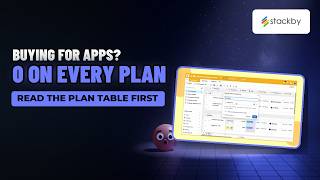
Here’s the part most people miss. The listing’s headline is “Transform your spreadsheets into AI powered business apps,” and its summary says you can “Build databases and apps (interfaces).” Then read the plan cards, row by row:
- Number of apps per stack: 0 on 1 to 5 codes. 1 from 6 codes. 2 at 9 codes, 3 at 10.
- Internal automations a month: 0 on 1 to 6 codes. 750 from 7 codes, 1,000 from 9.
- Custom apps or interfaces: crossed out on 1 to 5 codes.
- AI fields: crossed out on 1 to 4 codes.
- Custom branding for apps: crossed out until 9 codes.
None of that is hidden; it’s on the cards. But it’s easy to read the headline, buy one code for $109, and expect apps. You won’t get them. Honestly, this listing rewards the buyer who scrolls.
What every tier does include is “Build with AI,” the AI MCP connector, and 100 conversational AI credits (500 from 9 codes).
Code by code
| Plan | Price |
|---|---|
| 1 code One person, data only |
$109 once |
| 3 codes A small team, data only |
$327 once |
| 5 codes AI fields and API |
$545 once |
| 6 codes The first tier with apps |
$654 once |
| 7 codes Apps and automations |
$763 once |
| 10 codes The full deal |
$1,090 once |
One-time prices on AppSumo; each tier is a number of stacked codes (1 to 10, four in-between tiers not shown here). Paid one-time add-ons, such as Powerups ($449) and the Apps Marketplace ($499), are sold only while the deal is live. Stackby's own subscriptions start with a Free plan; Economy is $149 a year for 3 users.
Prices checked Oct 29, 2026 on Stackby’s own pricing page. Lifetime deals are listings that can end or change, so check the live listing before you buy.
The table shows the six tiers where something important changes. The four in between mostly add users, stacks and rows. In short:
1 or 2 codes ($109 or $218). One or two users, 20 stacks, 5,000 or 7,000 rows per stack, 4 GB of attachments per stack, 60 days of revision history. A shared database, forms and views. No apps, no automations, no API runs. Form branding starts at 2 codes.
3 or 4 codes ($327 or $436). Three or four users, 25 stacks, 10,000 rows per stack, 10 GB of attachments. Revision history goes to 180 days at 4 codes.
5 codes ($545). Five users, 30 stacks, 15,000 rows. This is where AI fields, API automated refresh and 500 API automation runs a month arrive.
6 codes ($654). The first tier with an app: one per stack, for up to 6 internal users, with subdomain mapping. Still no internal automations.
7 and 8 codes ($763 and $872). 750 internal automations a month, 35 stacks and 20,000 rows.
9 and 10 codes ($981 and $1,090). 10 or 12 users, 40 stacks, 25,000 rows, 1,000 automations, 2 or 3 apps per stack, a custom domain for apps, custom app branding and 500 AI credits.
Compare it with Stackby’s own Free plan
Before buying one code, read Stackby’s pricing page. Its Free plan lists 20 stacks and 1,500 rows per stack, and “Up to 5 Users,” with 5 editors and 50 read-only users per workspace. One AppSumo code lists 1 user and 20 stacks, with more rows per stack.
So for a small team that fits in 1,500 rows a stack, the Free plan already does the basic job, with more people. The 1-code deal makes sense mainly when one person needs bigger stacks, more attachments and the AI builder. When you plan to share with a team, price the tier with the users you need, not the cheapest one.
Stackby’s paid subscriptions, on the same page, include Economy at $149 a year billed for 3 users, Business at $299 and Pro at $449. The page also shows a second price table with different plan names, including Business Plus at $35 per seat per month, which made the comparison harder than it should be.
The terms, and the add-ons
The deal terms say:
- “All future Economy Scale Plan updates.” We couldn’t find a plan called “Economy Scale” on Stackby’s pricing page, only “Economy.” Ask which plan that maps to.
- “You must redeem your code(s) within 60 days of purchase.”
- “Stack up to 10 codes.”
- “Previous AppSumo customers will be grandfathered into any new features and feature limits.”
Then come the paid add-ons, each a one-time payment: Powerups for $449, the Apps Marketplace for $499, extra automation runs from $149 (3,000 a month) up to $699 (30,000 a month), sync across databases for $349, a CRM package for $399, and more. The terms add that “Optional add-ons are only available while the deal is available on the store.” When you think you’ll need one, buy it while you can.
The refund window is shorter than on many AppSumo listings: “Refundable up to 30 days,” not 60. The listing is, however, “Covered by our We Got Your Back guarantee” and described as “Carefully selected by AppSumo for quality, performance, and support.”
Who Stackby suits
A freelancer tracking clients and projects. One code works if you’re the only user and want bigger stacks than Free. In practice, try Free first.
A five-person team replacing a messy shared spreadsheet. Five codes ($545) gets everyone in, with AI fields and API refresh. Skip apps unless someone actually needs a custom interface.
An agency building client portals. Apps start at 6 codes, external app users are an add-on, and custom app branding needs 9. Price the full path, add-ons included, before committing.
A team that runs on automations. Internal automations start at 7 codes ($763). If you’ve already got Zapier or Make doing that work, you may not need them inside Stackby.
Common mistakes with the Stackby deal
Buying one code for a team. One code is one user. If you’ve got four colleagues who’ll edit, you need more codes, or the Free plan’s editors.
Counting stacks, not rows. Twenty stacks sounds roomy. A single customer table with 6,000 entries already breaks the 1-code ceiling of 5,000 rows per stack, so measure your largest sheet, not your number of sheets.
Waiting on the add-ons. Powerups, the Apps Marketplace and the automation packs disappear when the deal leaves the store. Don’t assume you can bolt them on next spring.
Treating the AI builder as unlimited. One hundred conversational credits is a starter allowance. When you plan to generate whole databases by prompt, test how quickly they drain.
Forgetting the window is 30 days. It turns out every other AppSumo deal we’ve reviewed so far gives 60, which trains buyers to relax. This one doesn’t.
How to test it inside the refund window
You get 30 days, so move fast.
- Redeem the codes the day you buy, and put day 30 in your calendar.
- Import your real spreadsheet, the messiest one, and rebuild the links and lookups.
- Build the view your team will open daily, and share a form with a colleague.
- Check your tier’s row limit against your biggest table, with a year of growth added.
- If you bought for apps or automations, build one of each before day 30.
What we couldn’t check
We didn’t test speed on large stacks, the quality of the AI builder, or support response times. We couldn’t confirm what “Economy Scale Plan” refers to, or exactly which features the 100 AI credits cover. Ask Stackby in writing during the refund window if any of that decides your purchase.
FAQ: Stackby questions
Does the Stackby lifetime deal include apps?
Only from 6 codes ($654), with one app per stack. Tiers of 1 to 5 codes show 0 apps per stack.
When do Stackby automations start on AppSumo?
Internal automations start at 7 codes, with 750 a month. API automation runs start at 5 codes.
Is Stackby free?
Stackby’s pricing page lists a Free plan with 20 stacks, 1,500 rows per stack and up to 5 users.
How long is the Stackby refund window?
Up to 30 days on AppSumo, and the listing is covered by AppSumo’s “We Got Your Back” guarantee.
The verdict
Stackby is a capable Airtable-style database with a long AppSumo history and AppSumo’s own guarantee behind this listing. The deal is good if you buy the right number of codes for the job: a few for a shared database, 6 or more for apps, 7 or more for automations. It’s a poor deal if you buy one code expecting the apps from the headline. Read the cards, compare with the Free plan, and decide within 30 days.
Stackby on our desks
Our YouTube channels cover Stackby from different angles. Each video opens on YouTube.
Guides on Business Software
- Is AppSumo Plus Worth It? The $99 Break-Even, Worked OutAppSumo Plus costs $99 a year and takes 10% off every order, plus $100 in coupons on the annual plan. Here's the break-even sum with real deal prices, and who should skip it.
- What Happens If an AppSumo Product Shuts Down?When an AppSumo tool closes, the lifetime deal ends with it. Whether you get anything back depends on the listing's We Got Your Back line, your Plus status, the purchase date and a 30-day claim deadline.
- What Is Stacking on AppSumo? Codes, Tiers and LimitsStacking means buying more than one code for the same AppSumo deal to reach a bigger plan. It only works on code deals the partner allows, and only while the deal is live.